From Eggos to homemade, waffles are a delicious and traditional breakfast and snack food. The waffle has a long history, beginning with Middle Age "wafers". Wafers were very thin, light, and crisp versions of the waffle. It was made in a wafer iron, a device resembling the modern day waffle iron. The wafer iron was two plates connected by a hinge with an attached wooden handle. The wafer irons were often fancy though, with designs and patterns included on the plates; coat-of-arms or even landscapes were used. The wafer was cooked in the iron over an open fire, and was flipped to ensure both sides were thoroughly cooked. Unlike modern day waffles, the wafers were unleavened, and made from barley and oats (as opposed to the flour used now). The wafers were sold in one of three ways, rolled into a cone (think waffle cones at Ben and Jerrys), a tube, or kept flat. Waferers were the name of the street vendors responsible for selling the wafers. Dutch pilgrims first brought waffles to North America in 1620, although Thomas Jefferson was responsible for introducing America to the waffle iron (a common item in France). An interesting fact, waffle "frolics" or parties were a popular social event in the late eighteenth century. Like today, waffles were eaten as a sweet treat with fruit and syrup, or as a more dinner type meal with kidney-stew on top.
There are two main types of waffles, the Brussels waffle and the Liege waffle. The Brussels waffle is better known as the Belgian Waffle in the United States. A yeast-leavened batter is used to help produce a lighter, crispier texture. It is traditionally sold by street vendors as a warm treat, topped with confectioner's sugar and possible whipped cream or chocolate or even served dessert-style, with fruit, whipped cream, or even ice cream. The Liege waffle is the second type. Like the Brussels waffle, it too can be found as a warm treat on the street. Rather than sold by street vendors though, they are usually found in small shops, or even grocery stores. Other differences from the Brussels waffle include the taste, size, and texture. They are sweet, smaller, and denser than it's waffle brother. The importance lies in the nib sugar (also known as pearl sugar, a type of refined sugar with large grains) added to the batter at the last second. This is used to create a distinctive caramelized sugar coating, another distinction from the Brussels waffle (and part of the reason for the sweetness). The Liege waffle is usually a plain treat, but can sometimes be accompanied by the usual toppings of fruit, cream, or chocolate. There is a third type of waffle but it is usually not recognized by true waffle aficionados. This is the so-called American waffle. Rather than a yeast leavened batter, the batter utilizes baking powder and egg whites. The egg whites serve to lighten the batter, although they are denser and thinner then the Brussels. In the United States, waffles are traditionally known as a breakfast food, covered with butter and syrups. They also have a broader appeal in such dishes as chicken and waffles.
Brussels Waffles
http://www.aopy00.dsl.pipex.com/recipes/waffles.shtml
Ingredients
3¼ cups plain flour
7g instant dried yeast (one sachet)
4 medium eggs
Whole milk
Vanilla extract
Two sticks (½ lb.) butter
Directions
1. Mix flour and yeast in a large bowl; beat in eggs one-by-one. Then add milk gradually, beating all the while, to make a thick batter. Melt butter and add gradually to the batter beating all the while. Add milk as required to give the batter the consistency of thick cream, add a few drops of vanilla extract. Cover with cling wrap and leave overnight at room temperature.
2. Heat the waffle iron, quite hot; brush lightly with butter or oil. Ladle batter into iron and close.
3. The waffles should be golden brown when they come out of the iron, not dark brown.
Liege Waffles
http://www.aopy00.dsl.pipex.com/recipes/liege_waffles.shtml
Ingredients
3¼ cups plain flour
7g instant dried yeast (one sachet)
2 medium eggs
1 cup whole milk
Two sticks (½ lb.) butter
2 oz. honey
Vanilla extract
10 oz pearl sugar
Directions
1. Mix flour and yeast in a large bowl; beat in eggs one-by-one. Then add milk and honey gradually, beating all the while, to make a thick batter or moist dough. Melt butter and add gradually to the batter, beating all the while. Cover with cling film and leave overnight at room temperature.
2. Pearl sugar may a little tricky to find. What I have found works best it to put granulated sugar into a clean frying pan or baking tray and add enough water to dampen the sugar. Then, on a low heat, dry out the sugar again, so that it forms a solid crust. Get the sugar out of the pan (by banging!), and then beat the sugar with a rolling pin to break it into small lumps (about half the size of a US sugar lump).
3. Mix the sugar lumps and vanilla extract into the dough and let it stand in a warm place for 15-30 minutes.
4. Heat the waffle iron; brush lightly with butter or oil. Ladle batter into iron (leave room for the batter to expand) and close. The waffles should be dark brown when they come out of the iron, not golden brown. The sugar melts out and caramelizes, so be careful taking the waffles out—the caramel will stick to your skin and burn you if you touch it.
References
http://augustinswaffles.gourmetfoodmall.net/StaticPage.php?pageid=257
http://user.gru.net/venkman/Waffles.html
http://www.experiencefestival.com/waffle_-_history__medieval_origins
Saturday, June 7, 2008


Wednesday, June 4, 2008
Dumpsters, not just for hobos anymore!
America throws away a lot of food. According to the Freegan website (freegan.info), nearly 30% of food produced in the US eventually gets thrown away. And this is happening while people here and aboard are going hungry, while food is being imported from other places to feed us, while the families who grew that food will never get to see it, and of course while Monsanto seizes control of our entire food chain by buying up one seed company after another.
Yesterday in class we had David Giles talk to us about dumpster diving. It is exactly what it sounds like: you find a food dumpster in your neighborhood that has the food you want, you wait until the business shuts down at the end of the day, you look in the dumpster and if it has that food in it, you climb into the dumpster to retrieve it. Now there are definitely certain risks you have to watch out for but it’s actually pretty safe. Just throw “dumpster diving” into Google and you will find hundreds of guides on how to do it and what foods are safe and what isn’t.
Dumpster diving has never really appealed to me but listening to David kind of made it sound a little more appealing. Plus the whole saving on groceries thing is pretty nice too. Even if I could cut my food bill in half each month, I would be saving over two hundred dollars. I just might try this dumpster diving and see how it turns out.
Friday, May 30, 2008
It's p-patch not pea patch
 I didn’t know we had any p-patches around the u-district. I was quite surprised to learn there was one just down the street from my house. I’ve driven past it easily hundreds of times and always thought it was just someone’s garden. It was interesting to see that even though it was a p-patch most of the plants were still flowers. I figured it would all be fruits and vegetables that could be eaten.
Teresa Mares’ talk about p-patches was also very interesting. I guess growing up in Colorado, there is so much farming that I never realized that anyone outside of those communities wanted to grow stuff too. I actually like the idea of the p-patch, a public piece of land devoted to something other than development. In their current state, I can never really see them as more than just a hobby but if they were bigger they could definitely be used to support individual communities.
I think it would be fun to own one of the plots myself. I’ve always thought that cooking my own food tastes better than going to a restaurant and I would imagine that growing what I cook would be even better than that. Plus, knowing how to farm for yourself would just be a good tool to be able to utilize.
Tuesday, May 27, 2008
(Portfolio) Just leave it up to chance
Genetically modified foods kind of freak me out. Not because I think of it as some sort of mutant plant, but because I believe that if we have to power to genetically alter a plant and basically grow how we want it to, there is little to stop us from genetically modifying animals to do the same. Now I know we’ve been selectively breeding plants and animals for millennia, but selective breeding and genetically altering an organism are two completely different things.
With selective breeding, there is still the element of chance; with genetic modification, you eliminate that element and you know exactly what your outcome will be. I mean, forget plants and animals, what would stop us from genetically modifying humans to be stronger, to be faster? What would stop the military from basically growing an army of super soldiers (think Nazi Germany as brought up by Karen-Sue Taussig in her article)? Sure that sounds like science fiction but so did genetically engineering plants to be better than they ever should have been.
Are we even so sure that messing with the genetic code of plants isn’t some going to affect anyone who eats that plant? Do we even really know what we are doing, and are we positive we know the outcome? What if some scientist got the calculations wrong, like maybe they spliced the wrong gene; we could end up with something straight out of a low-budget horror film. I don’t know about you, but the ability to genetically modify something to your own specifications definitely freaks me out a little.
With selective breeding, there is still the element of chance; with genetic modification, you eliminate that element and you know exactly what your outcome will be. I mean, forget plants and animals, what would stop us from genetically modifying humans to be stronger, to be faster? What would stop the military from basically growing an army of super soldiers (think Nazi Germany as brought up by Karen-Sue Taussig in her article)? Sure that sounds like science fiction but so did genetically engineering plants to be better than they ever should have been.
Are we even so sure that messing with the genetic code of plants isn’t some going to affect anyone who eats that plant? Do we even really know what we are doing, and are we positive we know the outcome? What if some scientist got the calculations wrong, like maybe they spliced the wrong gene; we could end up with something straight out of a low-budget horror film. I don’t know about you, but the ability to genetically modify something to your own specifications definitely freaks me out a little.
Friday, May 23, 2008
(Portfolio) To be or not to be... a vegetarian
I don’t know if I ever really made a conscious decision to eat meat, it’s just how I’ve always been; I love a good steak (in fact I just had one that was excellent). I don’t have anything against vegetarians or vegans, I just like red meat. If you choose not to eat meat, or any animal products for that matter, that’s your choice, but that’s not for me.
Vegetarians and vegans complain about the slaughtering of animals for the production of meat, yet they eat plants while they’re still alive and photosynthesizing. Just because plants don't have a mouth to cry out doesn't really make it any better. I know that sounds a little silly, but if you think about it, it’s true.
Michael Pollan poses the idea that as everything in today’s industrial world is highly dependent on fossil fuels (which of course harm the planet in every imaginable way). Therefore, possibly the most ethical thing is to eat animals, as more fossil fuels would be necessary to raise and transport vegetarian approved foods.
I do agree that the conditions in which the animals live and ultimately die are pretty miserable and I do think there could be something done about that, I just don’t think not eating meat all together is really the solution to that problem.
During our cooking adventure yesterday, we prepared vegan lentil soup and I’ll admit it wasn’t bad. I kept feeling like it was missing something though. I couldn’t quite put my finger on it until one of our classmates said this would be good as a stew and that’s when it hit me; the soup needed some meat to it. Now I’m not saying that meat was a necessity, but I just think the soup would have been richer with some pieces of flank steak or maybe some tender chunks of lamb and of course maybe a little more spice.
Vegetarians and vegans complain about the slaughtering of animals for the production of meat, yet they eat plants while they’re still alive and photosynthesizing. Just because plants don't have a mouth to cry out doesn't really make it any better. I know that sounds a little silly, but if you think about it, it’s true.
Michael Pollan poses the idea that as everything in today’s industrial world is highly dependent on fossil fuels (which of course harm the planet in every imaginable way). Therefore, possibly the most ethical thing is to eat animals, as more fossil fuels would be necessary to raise and transport vegetarian approved foods.
I do agree that the conditions in which the animals live and ultimately die are pretty miserable and I do think there could be something done about that, I just don’t think not eating meat all together is really the solution to that problem.
During our cooking adventure yesterday, we prepared vegan lentil soup and I’ll admit it wasn’t bad. I kept feeling like it was missing something though. I couldn’t quite put my finger on it until one of our classmates said this would be good as a stew and that’s when it hit me; the soup needed some meat to it. Now I’m not saying that meat was a necessity, but I just think the soup would have been richer with some pieces of flank steak or maybe some tender chunks of lamb and of course maybe a little more spice.
Friday, May 16, 2008
Fast food nation
Yesterday in class, Ann treated us to a good ‘ol American meal, Diet Coke and Ramen noodles. In my last blog, I talked about commodified taste and you can’t get more commodified that Diet Coke and Ramen noodles. While we were enjoying this fabulous meal, Ann had us write down what was on our mind while we ate. For the Ramen, I wrote things like “doesn’t smell like it tastes,” “chickenized,” “salty,” and “gives me a headache after a while.” Now that’s probably not the best list of things to describe a product, but Diet Coke didn’t score much better. For that I had things like “watery,” “not a good aftertaste,” syrupy,” and “doesn’t go down very well.”
Like the Taco Bell that I mentioned in my last blog, Diet Coke and Ramen noodles are another of America’s commodified tastes. Alison Leitch talks about the Slow Food Movement in her article as a way to try to move away from these commodified, fast foods. I pulled up the Wikipedia on the Slow Food Movement and here is what it says, “The Slow Food Movement was founded by Carlo Petrini in Italy as a resistance movement to combat fast food. It claims to preserve the cultural cuisine and the associated food plants and seeds, domestic animals, and farming within an ecoregion.” This is pretty much the exact opposite of Diet Coke and Ramen. The exercise today was not only a fun way to illustrate the Leitch article but it actually is a little bit of an eye-opener as to not only how commodified our taste has become (taste about more in the previous post) but that we really have become a “fast food” nation.
Tuesday, May 13, 2008
Mmmmm… Taco Bell
Let's talk about commodified taste. So what really is a commodified taste? In class we talked about how food, and thus taste, is becoming more and more produced for the consumer instead of produced by the consumer. The Haden article talks about how technology has made food easy to obtain and convenient. You can freeze whole meals in a factory and a consumer can take it home and heat it up and have a representation of a home cooked meal. You can go to fast food restaurants and get whole dinners for less than a couple of gallons of gas. You can even have it all delivered to you if you don’t want to move at all. Food is convenient, food is cheap, and taste has become a commodity.
 I think fast food is a great example of this and that is where Taco Bell comes into play. I absolutely love Taco Bell. I eat there at least once if not twice a week and it never gets old. I’ve had probably everything on the menu multiple times and I still go back for more. Sure just about everything tastes the same; the burritos taste like the tacos and the chalupas taste like the crunch-wrap supremes. But that taste has been commodified and is now being sold to millions of people. I know it’s probably slowly killing me, but it’s cheap and easy…and isn’t that really what food and taste is about now-a-days. Who has the time to cook home-cooked meals every day? With school and work, I’m lucky if I even eat dinner at a reasonable time. I try to cook as much as I can but the allure of cheap and easy is just too great sometimes.
I think fast food is a great example of this and that is where Taco Bell comes into play. I absolutely love Taco Bell. I eat there at least once if not twice a week and it never gets old. I’ve had probably everything on the menu multiple times and I still go back for more. Sure just about everything tastes the same; the burritos taste like the tacos and the chalupas taste like the crunch-wrap supremes. But that taste has been commodified and is now being sold to millions of people. I know it’s probably slowly killing me, but it’s cheap and easy…and isn’t that really what food and taste is about now-a-days. Who has the time to cook home-cooked meals every day? With school and work, I’m lucky if I even eat dinner at a reasonable time. I try to cook as much as I can but the allure of cheap and easy is just too great sometimes.
Thursday, May 8, 2008
Man, those Johns are Hoppin!
Today in class, our group worked on preparing a southern dish called Hoppin' Johns. It is a one-pot dish made with black-eyed peas, onions, garlic, and vegetable broth. Having no ancestry in the south and actually not knowing that many people from the south either, this dish was completely new to me; as was the other dish we made in class, collard greens. Now both of these are southern dishes but to be honest, I’ve always associated them with slavery and actually I believe that is how they got their start. I did a little research and according to epicurious.com “throughout the South this humble dish of ‘peas’ and rice is eaten on New Year's Day for good luck, with a plate of [collard] greens, cooked with a hog jowl and plenty of corn bread to sop up the pot likker.”
I was pretty fun to cook today in the kitchen; I can just imagine how it would be down south. Our group would taste the Hoppin’ Johns every now and then to see how they were doing and if we needed to ass anything. The funny thing is that none of us had ever had them before so we really only were adding things that would make them good to us and probably not keeping with the southern tradition of it all. It was funny because we would ask each other what it needed as if we actually knew but in the end, they actually turned out pretty good (could have used a little spice, but that’s ok…sorry Annie).
I was pretty fun to cook today in the kitchen; I can just imagine how it would be down south. Our group would taste the Hoppin’ Johns every now and then to see how they were doing and if we needed to ass anything. The funny thing is that none of us had ever had them before so we really only were adding things that would make them good to us and probably not keeping with the southern tradition of it all. It was funny because we would ask each other what it needed as if we actually knew but in the end, they actually turned out pretty good (could have used a little spice, but that’s ok…sorry Annie).
Wednesday, May 7, 2008
(Portfolio) Racist food
Food definitely has a race, a gender, an ethnicity, and a class; well maybe not so much a gender, but the other three for sure. I also believe that food has a specific region as well. There are stereotypes that exist for food with regards to race and there are certainly so-called ethnic foods. As for food and class, there are foods which only the upper class can afford and vice-versa for the lower classes. There is soul food, Asian food, Indian food, and even white food.
The Rouse/Hoskins article touched on “soul food” but I think their ideas can be expanded to talk about all food. All food has been given a race, an ethnicity, a class, and by default of where it comes from, a region. Rice is Asian and spans all classes. Collard greens are southern and started as a lower class food, but have since moved to be a more middle class dish. Curry is Indian, corn is central American, the list goes on.
I feel like there are even foods that I relate to better than others because of where I grew up and what food I grew up with. I love spicy foods, especially Mexican food, and I think that has a little to do with growing up in Denver. I would imagine if I grew up in Seattle, I would feel the same way about Thai or Vietnamese. Food is regional and the region also gives it it’s race, it’s ethnicity, and it’s class.
The Rouse/Hoskins article touched on “soul food” but I think their ideas can be expanded to talk about all food. All food has been given a race, an ethnicity, a class, and by default of where it comes from, a region. Rice is Asian and spans all classes. Collard greens are southern and started as a lower class food, but have since moved to be a more middle class dish. Curry is Indian, corn is central American, the list goes on.
I feel like there are even foods that I relate to better than others because of where I grew up and what food I grew up with. I love spicy foods, especially Mexican food, and I think that has a little to do with growing up in Denver. I would imagine if I grew up in Seattle, I would feel the same way about Thai or Vietnamese. Food is regional and the region also gives it it’s race, it’s ethnicity, and it’s class.
Friday, May 2, 2008
(Portfolio) The future of food is not looking so good
 What is the future of food? I asked my girlfriend this same question and her answer was full meals in pill form. To her, it would be more efficient because you could pack a whole day’s worth of nutrition into one little pill. Meals would take only a minute or two and we’d be full after just a single pill. The sad part is that I actually believe there is some truth in what she says. The film, The Future of Food discusses the dependence of humans on a limited number of global food corporations and the increased risk of ecological disasters resulting from the reduction of biological diversity (something I actually talked about in a Environmental Anthropology class I took a while back) due to the promotion of corporate sponsored monoculture farming.
In our current food crisis, we will not survive a famine caused by a lack of diversity in our crops. Even if we are able to protect the crops against such a disaster, our soil cannot last much longer because of our intensive agricultural lifestyle. Eventually someone has to step in with a solution or our food crisis is going to get even worse. I fear one solution might be “pilled” food. To a pharmaceutical, it would be cheap to produce because they already have to facilities to do it. This a grim end to food but if we keep going to way we are, is there really any other way?
Saturday, April 26, 2008
Food and memory
I’ve always had different memories associated with different foods but none more strongly with McDonalds Hotcakes. Now I know you’re saying to yourself, “McDonalds, really?” but bear with me. So I swam all through high school and we had morning practice 3 times a week. To make it to the 5:15am practice, I had to get up at 4:15am (which actually turned out to be more like 4:45am) which usually let me little time for breakfast. I usually managed to down a bowl of cheerios and some milk and juice but that was really only enough to get me through practice. So after practice most of us varsity guys would go down to McDonalds and get breakfast (probably not the most healthy thing in the world but with 9 practices a week, it didn’t really matter what we ate). Sometimes we’d eat down there but most of the time we would bring it back to the school and eat it in the cafeteria at the big round tables. This was always the best part of the swimming season (I mean besides state and nationals) because I think it added to the camaraderie of the team.
I’ve been to McDonalds a few times since high school and even just the smell of the hotcakes is enough to remind me of the great times I had during my four years of high school swimming. But that’s the thing, it’s just a memory. I’ve sat down with the same group of guys and had the same breakfast but it was never the same; they didn’t taste the same and the whole experience just wasn’t the same. McDonalds hotcakes are my breast of Aphrodite. Although they have never disappeared or really changed at all, my buddies and I have all changed and it’s just not the same; it doesn’t make me feel like I’m back in high school, dead tired after a killer practice.
Wednesday, April 23, 2008
I'll give it 3 stars
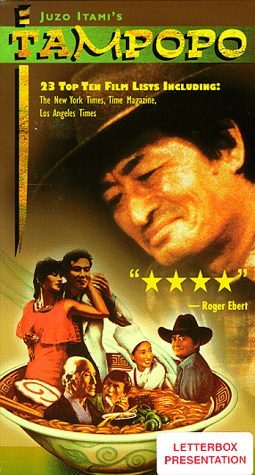 Tampopo… now that was an interesting movie. I just pulled up IMDB and discovered that Gun was actually played by a young Ken Watanabe (most of you would know him from playing Lord Katsumoto in The Last Samurai). Tampopo was actually one of his first movies so it’s interesting to see where people started out and where they have come.
 The movie was definitely an acquired taste. There were some parts I liked (like the hobo scene) but there were some parts I could have passed on (the egg scene for one). But at its core, I would say the movie is about the sensual, even erotic nature of food, and the lengths to which people will go to strive for ideal relationships with the food we eat and the people we meet.
I was watching the hobo scene thinking I’ve seen something like this before and it just struck me where, on a Futurama episode. There is a scene with hobos that is based on the hobo scene from Tampopo, where of course hobos with a love of food come together to share their culinary discoveries under the guidance of a master of ramen. I wish we could have seen the end of the movie but I guess I’ll have to wait until it comes in on my Netflix.
Thursday, April 17, 2008
Obento for you, Obento for me
I enjoyed the obento exchange today; I actually thought it was a lot of fun. There were definitely some interesting ingredients we had at our disposal. The rice and seaweed were pretty normal to me since I eat a lot of sushi and I really enjoyed the salmon flakes, they gave a nice flavor to the rice, but I found that the fish tube things were definitely a little weird; not only taste but the texture as well. There were two other things I found to be a little weird, one was red and one was yellow. I don’t really remember what they were called but they both had an interesting taste. My favorite part was definitely the pepper. It had a little bit of a kick to it which I’ll admit surprised me, but I thought it was pretty good.


Image Credit: Ann Anagnost
Actually making an obento box was a good experience because it opened up a whole new door for me. Now I’m not saying that I’ll be making these from now on and taking them to class with me (not enough food plus too much time to make it) but it is definitely interesting to see what a mother has to go through in the morning to make her kids’ lunches. To these little Japanese kids, it is just a lunch but to me, it is an art form. It just amazes me the way everything is put together and organized.
Tuesday, April 15, 2008
Obento, oh really?
Food has always tasted better when it is aesthetically pleasing. I like food that looks good because most of the time it is good. There are definitely some exceptions to this rule; pizza comes to mind, it’s usually not that attractive but damn it sure is good. Food to me is an art form; the way it is presented on a plate, the way one color contrasts another or the way they complement each other. This is why the idea behind a bento box is so appealing to me.
It was interesting not only to hear to what Andrea had to say but to listen to what the Japanese students talked about as well. For them, a bento box is just a lunch but to us it is almost like an art piece. I think back to my days of a packed lunch (brown paper sack, PB&J, string cheese, an apple, and a thermos full of milk) and I wonder if there is any way to make that look as appetizing as a bento box. I can’t think of any, but maybe y’all can.
I look forward to making my own bento box or at least attempting it, but I will never be able to make it as good as this
Thursday, April 10, 2008
(Portfolio) The Cuba diet is not for me!
I'm actually touching up a post from last week I never got to put up because of some unrelated problems with our Comcast connection (don’t get me started), but nonetheless, here it is. This past week I tried something new…it’s called the Cuba Diet and I definitely found out it was not for me.
I started by calculating out how many calories I take in on any given day and I came up with a ballpark figure of 4000-5000 calories. That seemed a little high, especially since recommended is around 2500, but my math checked out. Four to five good meals a day plus snacking is what I use to keep me going (loving food makes it a little easier to be eating all the time). So I knew right away trying to experience what Cubans had been going through was going to be tough but I figured I would try it anyway.
Dumb idea. I got up the next morning and had a pretty small breakfast. Two hours later my stomach was growling so I had a few handfuls of pretzels. That kept me running until lunch but again nothing too fancy, just a couple of sandwiches. Mid-afternoon rolled around and again my stomach was begging me for some more food so I popped some wheat thins and made it to dinner; cooked myself up some chicken and rice with a nice teriyaki sauce. So by then end of the day, I’d say my caloric intake was probably in the range of 2000 calories.
I have no idea how a person could do that day after day especially working. I was hungry most of the day and all I did was sit around and either do homework or watch TV. If I would have thrown in working out or anything physical, I probably would have passed out. I guess I could probably get used to eating like that but I think it would take some time. Basically what I’m trying to say is that I’m glad that the caloric intake of the Cubans is back to normal because the Cuban Diet is not the way to go.
Thursday, April 3, 2008
Free Write
I love food, especially spicy food. I grew up in Colorado so I’ve always associated spicy food with my childhood and especially my dad. Every time we do out to a Mexican restaurant, we always see who can get the spiciest meal. We started out getting jalapenos with every meal but those have since lost their kick; I can basically eat them like pickles now. Now we’ve moved onto habanero peppers. Those little suckers are hot; we’re talking nose-running, ears-burning hot. Every time I eat any type of food with habanero peppers in it, it always makes me think of home and especially of my family. I’ve gotten a little more used to the heat of a habanero but I can still remember the first time my dad and I chomped down on one; eyes teared up, face turned red but damn I was hooked.
Subscribe to:
Posts (Atom)

